Below are some commonly asked questions that NACFOR has been asked by members of the public. In an effort to increase public engagement and awareness, NACFOR will regularly post simple explanations about our operations here on our website and in our newsletter. Sign up for our newsletter here.
How does the community forest manage and protect forest values such as wildlife, including species at risk, fish, community watersheds, visual quality, cultural values, old growth, soils, forage and non-timber forest products, recreation values, and biodiversity?
- All Nakusp and Area Community Forest operations are guided by our Management Plan and Forest Stewardship Plan (FSP). The FSP is a regulatory document developed specifically for our land base that outlines the strategies to be taken to ensure the desired results for the above values are achieved during forest development and harvesting. The FSP also outlines how NACFOR consults and engages with the public, First Nations and stakeholders regarding land-based activities. The FSP has a 5-year term, and at that point, a new plan is developed for the land base to ensure that management actions are consistent with evolving, modern forest management practices. The current FSP document is on our website here.
How will the new NACFOR tenure be managed? What are the plans?
- The expanded tenure area will be managed with the same practices, guided by our Forest Stewardship Plan and Management Plan, as the rest of the NACFOR existing tenure. Currently, the expanded area has not had field assessments, harvesting or operational plans created for it. This summer, crews will conduct initial assessments.
What does Annual Allowable Cut mean?
- Annual Allowable Cut, or ACC, is the maximum amount of volume that the community forest is allowed to harvest each year under our Community Forest Agreement with the Province of BC. NACFOR’s AAC is 20,000 cubic metres, about 500 truckloads of timber. Historically, NACFOR has not cut this volume on our land base in one year, and averages a bit less. This AAC needs to be met over a 5 year period (called the cut control period) to meet regulatory requirements. This is what we mean when we say we need to continue to harvest timber from our tenure, and regularly rotate areas for harvesting so as to spread the demand across our land base.
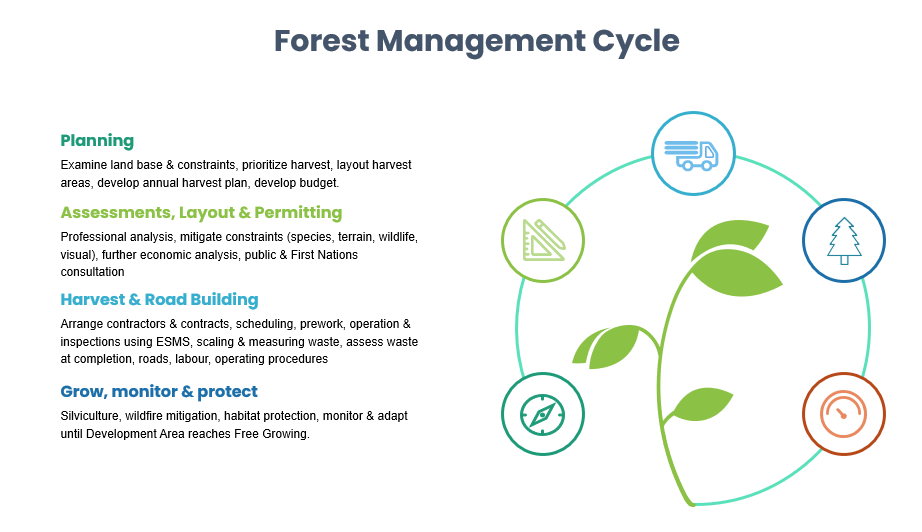
What happens before you log or harvest? What goes into the planning?
- For commercial harvesting operations, the following steps are taken for each development area: